The history of Leamington Spa Art Gallery & Museum
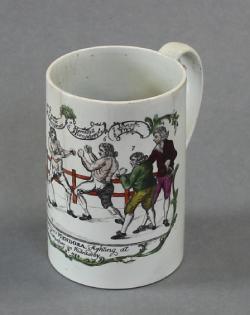
This mug commemorating a boxing match between Richard Humphreys and Daniel Mendoza is the earliest acquisition in the collection. It was given to us in 1873.
The collections of Leamington Spa Art Gallery & Museum have their foundations in the pictures and museum specimens that were donated to Leamington Free Public Library from the early 1860s. In 1875/6 the collection was sufficiently well established to cause the managing Free Library Committee to form a separate Museum Committee. In those early years, the museum collection was housed alongside the library in different location in the town, such as Denby Villa and, from 1885, the new Town Hall on the Parade. A purpose-built public library was opened in 1902, with the museum collection and displays relocating there in 1915/6. The growth of the collection, combined with a desire to provide space for a children’s library, led to the building of an extension to accommodate an art gallery and museum in 1928. At the same time a separate Art Collection was established along with an Art Gallery Advisory sub-committee to oversee the acquisition of artworks for the collection. The gallery space was further enlarged in 1938 when the East Wing was extended.
The Art Gallery building was requisitioned during the Second World War to house the Camouflage Directorate. After being released, it was refurbished and reopened on 28 July 1947. That year a Museum Sub Committee was formed to consider collecting and disposals. Mr S.C. Kaines Smith, Keeper of the Cook Collection and former Director of Birmingham Museum and Art Gallery, was invited to advise. He recommended that the Natural History collection should be discontinued, with emphasis instead placed on building up a representative collection of 20th century English pictures; developing the pottery and porcelain collections; to begin the acquisition of English glass and silver; and to develop the local history collections and bygones generally. This resulted in significant growth to the decorative arts collection in the 1950s and ‘60s.
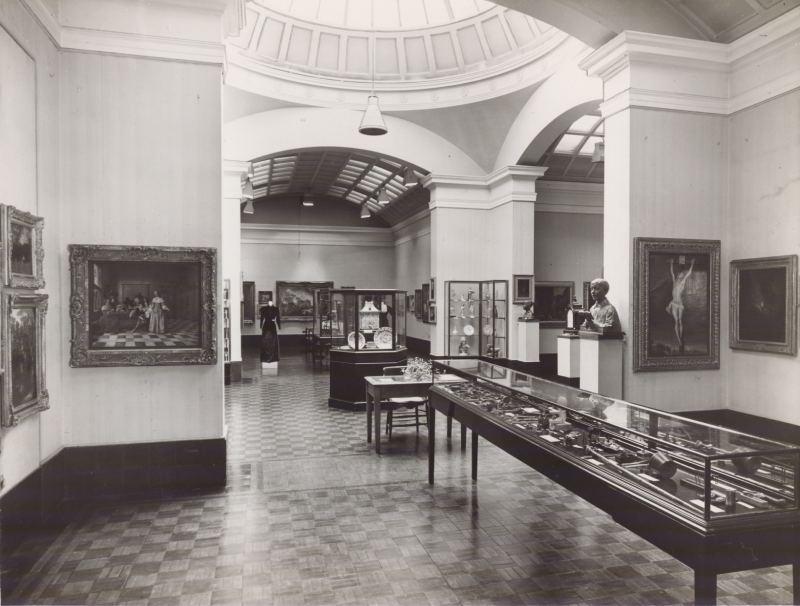
Leamington Spa Art Gallery & Museum on Avenue Road in 1958
Following the reorganisation of local government in 1974, the administration of the museum was separated from that of the library and given to the newly formed Warwick District Council. In 1988 the policy document, A Museum and Exhibition Service for the 1990s, written by the Museums and Exhibitions Manager Jeff Watkin, recommended that the museum service should concentrate on human history which covered areas in which the collections were particularly strong. The following year the botanical and zoological collections were transferred to the Herbert Art Gallery & Museum in Coventry, and the Geological collection was transferred to Warwickshire Museum.
In 1999 the Art Gallery & Museum service moved to new premises in the Grade II listed Royal Pump Rooms. Drawing on the building’s history as a medical treatment centre, a new collecting programme, Medicate (1999-2005) was introduced. With funding from the Wellcome Trust and the MLA/V&A Purchase Grant Fund, a group of works by contemporary artists that explored the links between medical science and art was acquired. These artworks complemented the medical equipment, photographs and ephemera that were transferred to the museum collection around the same time. The town’s history as a spa resort continues to shape its identity and is reflected in its collections.
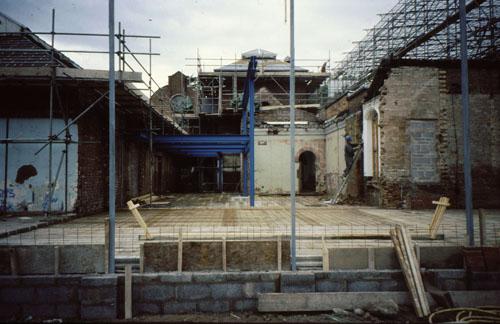
Building the Museum, July 1998